So far Reading God's Story has spread out the psalms over the course of David's life. I have enjoyed seeing the psalms connected to events in his life, such as Psalms 35, 54, 63 placed after 1 Samuel 27, at which point David has gone to live with the Philistines in order to flee Saul's jealousy and wrath. Verses like "ruthless people are trying to kill me - people without regard for God" take on added meaning when you have just read about the way Saul has treated David. Many of the Psalms are situational; they are the psalmist's prayer to God based on his circumstances. The placement of the Psalms in RGS helps us to see how David does just that, crying out to God in the midst of persecution.
Other Psalms help us see the "big story" of the Bible. Psalm 78 looks all the way back to Israel's journey in the wilderness, the miracles God did for them there, and their unending demands and complaints against God. It contrasts God's enduring faithfulness to his people and their lack of faith in his provision. It describes what happened once they reached the land; the people turned to idolatry and God in his anger abandoned them to their ways. They lost the ark of the covenant in battle; their young men were killed; their enemies triumphed over them. But that did not last forever; God beat back their enemies. The psalm leads all the way to the events I am reading about right now - God's choice of David to be their shepherd.
--------------
There is a wonderful music group in Durham, NC called Folk Psalm. They set the psalms to music. They played for us at Duke Divinity School a few times. Here is a video about their music and ministry:
http://www.faithandleadership.com/multimedia/sing-praises-god
Here is their website:
http://www.folkpsalm.com/
Thursday, May 10, 2012

Monday, May 7, 2012
the Chronic(what?)cles of Israel
Chronicles starts out with a bang, doesn't it? Kidding :) It is tough going slogging through all those lists in the first 9 chapters of Chronicles (so it's nice that RGS spaces them out over several days). The genealogies is helpful because they give us a review and overview of the "big story" so far in the Bible - Adam, Noah, Abraham, Isaac, Jacob and all of his sons. There are also glimpses of the unusual twists and turns that the story has taken - sometimes the line takes a very untraditional twist. Whereas we would expect the line to continue after Jacob with Reuben, his firstborn, instead it goes through the fourth-born son, Judah. All 3 of Judah's son born by his wife die, so the line continues on through the child Judah has with his *daughter-in-law* Tamar. Again, we see that God does not insist upon a perfect, proper, pure genealogy; he accomplishes his work despite and even through the messiness of human behavior and relationships. At the beginning of Chronicles, the concern here is to trace the genealogical line from Adam to David. As Christians, this takes on added significance, because we will see the gospel writers using genealogies to show how that same line eventually leads to Jesus.
The story of David is told in two different places in the Old Testament. We began reading about it in Samuel, but now we are also reading it on a parallel track in Chronicles. Whereas Samuel gives that full picture of David I described earlier, Chronicles does not mention the sin, the brokenness, the mistakes in David's life. It is a more idealized picture of David as the Messianic king. It's therefore important to read both books in order to get a fuller portrait of David.
If you want to learn more about Chronicles, I just discovered that the introductions to each book of the Bible in the NIV study Bible are available online for free. Here is the one on 1 Chronicles.
(title of this blog post is a take on Andy Samberg's "Lazy Sunday" video on SNL.)
Thursday, May 3, 2012
Using Blue Letter Bible
One of the my goals with this blog is help you connect with resources that deepen your understanding of the text. Blue Letter Bible is my favorite website for digging into the Hebrew and Greek words of the original text of the Bible and understanding what those words meant in their original context. Don't worry, you do not need to know Greek in order to learn a lot through this website.
I am much more familiar with Greek and will therefore probably use this website more often once we get to the New Testament. (FYI, the Old Testament is written in Hebrew, and the New Testament is written almost entirely in Greek.) However, I want to introduce you to the website now in case you are interested in exploring words from our readings now!
Head to Blue Letter Bible and enter the reference for the text you are studying. You can either enter just the name of the book of the Bible and chapter number, or you can also add the verse number. (I have added screen shots below to help you.) This time I am using BLB to look up John 15, because that is the gospel reading for this coming Sunday and the passage that I have been writing about for our church's Easter blog Living Into Joy.
 Once you ask BLB to search for that text, you'll see that a screen comes up with the chapter, with each verse listed separately.

You'll see that in the 6 little boxes to the left of each verse, one is labeled "C." That "C" is for "Concordance." Here I am going to choose John 15:11, because I want to look up the word for "joy" in Greek, so I click on the "C" next to verse 11.

Now the verse expands to show me the verse in Greek at the top and then each word in English listed separately with the Greek word to its right along with the Greek word's Strong's Number. (Strong's is a Bible concordance that's been since 1890; Dr. Strong assigned each Greek word a number for reference purposes. If you're interested, you can learn about its history here.) To learn more about the Greek word, click on the Strong's number. For example, here I will click on the G5479.

Now a new page opens filled with information about this one word in Greek. It is listed in Greek at the very top in large letters, but then it shows its spelling in English and gives an audio file of its pronunciation. It also gives a detailed definition of how the word is used in the Bible under "Outline of Biblical Usage" and lists how many times the word is used in the New Testament.
If you keep scrolling down that same page, you'll find a listing of all the verses in which that word is used in the New Testament.

This is helpful because it saves you the time of looking up each verse either online or in your Bible. I often use this to get a sense of how the same word is used in different contexts across the New Testament, both to see how it's used in similar ways and in different ways.
If you ever wondered what a word meant in its original context, give BLB a whirl and see what you discover. If you have any questions about how to use BLB, please feel free to contact me.
I am much more familiar with Greek and will therefore probably use this website more often once we get to the New Testament. (FYI, the Old Testament is written in Hebrew, and the New Testament is written almost entirely in Greek.) However, I want to introduce you to the website now in case you are interested in exploring words from our readings now!
Head to Blue Letter Bible and enter the reference for the text you are studying. You can either enter just the name of the book of the Bible and chapter number, or you can also add the verse number. (I have added screen shots below to help you.) This time I am using BLB to look up John 15, because that is the gospel reading for this coming Sunday and the passage that I have been writing about for our church's Easter blog Living Into Joy.


You'll see that in the 6 little boxes to the left of each verse, one is labeled "C." That "C" is for "Concordance." Here I am going to choose John 15:11, because I want to look up the word for "joy" in Greek, so I click on the "C" next to verse 11.

Now the verse expands to show me the verse in Greek at the top and then each word in English listed separately with the Greek word to its right along with the Greek word's Strong's Number. (Strong's is a Bible concordance that's been since 1890; Dr. Strong assigned each Greek word a number for reference purposes. If you're interested, you can learn about its history here.) To learn more about the Greek word, click on the Strong's number. For example, here I will click on the G5479.

Now a new page opens filled with information about this one word in Greek. It is listed in Greek at the very top in large letters, but then it shows its spelling in English and gives an audio file of its pronunciation. It also gives a detailed definition of how the word is used in the Bible under "Outline of Biblical Usage" and lists how many times the word is used in the New Testament.
If you keep scrolling down that same page, you'll find a listing of all the verses in which that word is used in the New Testament.

This is helpful because it saves you the time of looking up each verse either online or in your Bible. I often use this to get a sense of how the same word is used in different contexts across the New Testament, both to see how it's used in similar ways and in different ways.
If you ever wondered what a word meant in its original context, give BLB a whirl and see what you discover. If you have any questions about how to use BLB, please feel free to contact me.
Wednesday, May 2, 2012
David at last!
I love the story of David. After the chaos of Judges and the disappointment of Saul, David emerges as a strong leader anointed by God to take Saul's place. I have been struck this week by just how long it takes David to finally reach the throne. Saul really makes things tough on him. I found it sad after the poignant portrayal of David and Jonathan's friendship, to learn of Jonathan's death through a list of names of Saul's sons who died in battle.
I love that Scripture portrays David in such an unflinching way. David is the greatest hero in the history of Israel from its time as a nation. The temptation would be to portray only his many strengths and victories, but the text does not shy away from his flaws and mistakes. It tells the whole story. It shows David needing to change his mind, to repent, to amend his life, time and time again. The contrast between David's willingness to change and Saul's repeated failure to change, despite his epiphanies here and there, is striking. In 3DM language, I'd say that David chooses to learn from life, but Saul passes over his kairos moments as though they were speed bumps :) David stops, reflects, and asks God is doing in his life and how he can respond to it. Saul admits at times that he's made mistakes and needs to change direction (how many times does he say, "David, you're right, I should really stop trying to kill you!"), but he ends up continuing down the same path, and it leads to his destruction.
As a resource for those who might want to study the story of David, I would recommend Rober Alter's translation of the David story which includes his commentary as well. He shows how this narrative is a cohesive and literarily brilliant one, rather than simply a patchwork of information about David from various literary sources. While his approach is more scholarly than faith-based, Alter's argument that the narrative is cohesive meshes well with the Christian view of the Bible as the inspired word of God.

Maps in a Digital Age:
I have found myself slowing down while reading because I want to have a sense of where in Israel these events are happening. I had been mostly turning to the maps in Reading God's Story, but many places aren't listed on those maps, so I would spend lots of time searching the entire map in vain. I finally hit upon a good solution for me - the Glo App on my iPhone. The Glo Bible is software that is packed with information about the Bible set up in an interactive way, so that you can explore maps, timelines, historical information about the Bible. The app has various levels of content that you can purchase, but there is a free version. If you have an iPhone, check it out. When I type in a location name, it immediately shows me the location on a satellite map; I can then click on the name to get more information about the location.
My Progress:
I am catching up on my reading and have decided to simply blog about whatever I'm reading instead of trying to catch up before starting to post again. If you're on track and I'm posting about stuff you read a couple weeks ago, my apologies!
I love that Scripture portrays David in such an unflinching way. David is the greatest hero in the history of Israel from its time as a nation. The temptation would be to portray only his many strengths and victories, but the text does not shy away from his flaws and mistakes. It tells the whole story. It shows David needing to change his mind, to repent, to amend his life, time and time again. The contrast between David's willingness to change and Saul's repeated failure to change, despite his epiphanies here and there, is striking. In 3DM language, I'd say that David chooses to learn from life, but Saul passes over his kairos moments as though they were speed bumps :) David stops, reflects, and asks God is doing in his life and how he can respond to it. Saul admits at times that he's made mistakes and needs to change direction (how many times does he say, "David, you're right, I should really stop trying to kill you!"), but he ends up continuing down the same path, and it leads to his destruction.
As a resource for those who might want to study the story of David, I would recommend Rober Alter's translation of the David story which includes his commentary as well. He shows how this narrative is a cohesive and literarily brilliant one, rather than simply a patchwork of information about David from various literary sources. While his approach is more scholarly than faith-based, Alter's argument that the narrative is cohesive meshes well with the Christian view of the Bible as the inspired word of God.

Maps in a Digital Age:
I have found myself slowing down while reading because I want to have a sense of where in Israel these events are happening. I had been mostly turning to the maps in Reading God's Story, but many places aren't listed on those maps, so I would spend lots of time searching the entire map in vain. I finally hit upon a good solution for me - the Glo App on my iPhone. The Glo Bible is software that is packed with information about the Bible set up in an interactive way, so that you can explore maps, timelines, historical information about the Bible. The app has various levels of content that you can purchase, but there is a free version. If you have an iPhone, check it out. When I type in a location name, it immediately shows me the location on a satellite map; I can then click on the name to get more information about the location.
My Progress:
I am catching up on my reading and have decided to simply blog about whatever I'm reading instead of trying to catch up before starting to post again. If you're on track and I'm posting about stuff you read a couple weeks ago, my apologies!
Thursday, April 12, 2012
Recap: Judges & Ruth
My long hiatus is over! Despite our church's focus on resting and listening to God, Lent has been a very busy time for me :)
Following on the heels of Judges is the beautiful little book of Ruth. As I read Ruth, I took heart, because I saw the thread of God's bigger story surfacing. Amid the chaos of the period of the Judges, we see a little glimmer of hope. We find a story of a young non-Israelite woman who chooses to become part of God's people because of her great love for her mother-in-law. She joins a long line of other non-Israelite women who are grafted into the line of David; Tamar (Genesis 38) and Rahab (Joshua 2) come to mind. Ruth continues the story of the genealogical line that was begun back with Abraham, that we traced through Jacob and Judah. It will result in King David.
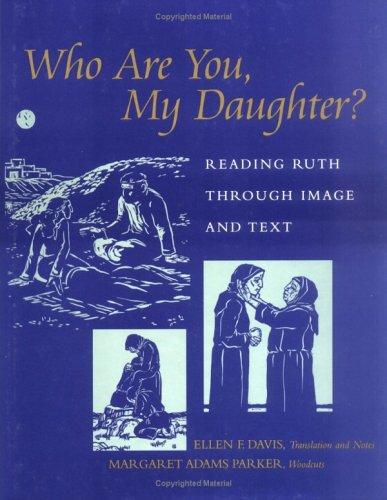
 My Old Testament professor, Ellen Davis, did a translation of Ruth and commissioned an artist to do woodcuts that correspond to the story. It's a lovely book called Who Are You, My Daughter?
Judges is a brutal book. I struggled my way through it. Judges tells the story of what happens once the people of Israel have arrived in the Promised Land and (mostly) driven out the people inhabiting it. Just in case you didn't know, once they settle in the land, God's people totally blow it. They devolve into infighting, violence; they get preoccupied with fighting their enemies. Throughout Judges, it feels as though we lose the plot. From Exodus through Deuteronomy, we had Moses as the strong leader figure who holds things together. Joshua takes his place. But when we get to Judges, the whole project devolves. The judges are appointed as leaders, but they come and go with varying degrees of faithfulness. While some of them do a great job of leading Israel, none of them seem to have the staying power or level of influence as Moses or Joshua did. To their credit, it is much harder to rally folks when they are spread out across the land rather than journeying together in the wilderness. The refrain of the book of Judges is, "In those day there was no king in Israel; everyone did whatever he wanted." Or, as the NASB puts it, "Everyone did what was right in his own eyes."
Following on the heels of Judges is the beautiful little book of Ruth. As I read Ruth, I took heart, because I saw the thread of God's bigger story surfacing. Amid the chaos of the period of the Judges, we see a little glimmer of hope. We find a story of a young non-Israelite woman who chooses to become part of God's people because of her great love for her mother-in-law. She joins a long line of other non-Israelite women who are grafted into the line of David; Tamar (Genesis 38) and Rahab (Joshua 2) come to mind. Ruth continues the story of the genealogical line that was begun back with Abraham, that we traced through Jacob and Judah. It will result in King David.
Dr. Davis taught us about one of the Hebrew key words of Ruth, hesed. It shows up throughout the book and means "covenant loyalty." Dr. Davis translates it as "acts-of-good-faith" in her book. For instance, in Ruth 1:8, when Naomi says to Ruth, "May the Lord do to you hesed as you have done with the dead and with me," Dr. Davis translates it as "May the Lord do with you acts-of-good-faith." The irony of this book is that a non-Israelite woman, Ruth, is the prime example of hesed in her loyalty to Naomi at a time when the Israelites themselves have recklessly abandoning the covenant. In saying, "Your people shall be my people, and your God shall be my God," Ruth is binding herself to the covenant people of God. While it is not said explicitly in the book of Ruth, this small story is about God's faithfulness, his hesed, to Israel. Even when the people are turning their backs on him, God is working ahead to provide for his people a redeemer, first in the person of David, later in the person of Christ.
We are reading about David now, and I will write about him next.
Friday, April 6, 2012
The Gospel is Sturdy Enough
I realize it's been nearly a month since I posted. My apologies. I will pick this back up in Easter, but in the meantime here is a posting for Holy Week - a homily I gave last night at St. George's.
___________________________
___________________________
Sarah Kerr
St. George's Episcopal Church, Nashville, TN
Maundy Thursday 2012 Homily
“This is my body broken for you. This is my blood shed for you.”
Tonight on this Thursday of Holy Week, we hear the story of the Last Supper, and we recall how Jesus commanded his disciples to remember him by celebrating this special meal together. That Last Supper that Jesus shared with his disciples was also a beginning – it was the First Eucharist, the first of countless celebrations that have happened through history and around the world since the first century, all in remembrance of Him. In our tradition we celebrate the Eucharist every Sunday – in fact, here at St. George's we celebrate the Eucharist every single day. Tonight is a special celebration of the Eucharist, because on this night we celebrate it as part of Holy Week, an intense and focused time when we remember the events of the week leading up to Jesus’ death and resurrection. As I have celebrated the Eucharist this Holy Week, I have noticed that doing so during this special season highlights the theme within the Eucharist of Christ’s physical suffering. We may not think about it every time we hear this, but each week when the liturgy echoes Jesus’ words at that final dinner, “This is my body given for you, this is my blood shed for you,” it points specifically to his physical suffering, to the way that his body was broken and his blood was shed by whips and thorns and nails.
In our beautiful Eucharist services, with our beautiful altar coverings and robes and silver chalices, it is easy to forget that such a violent and painful story lies behind it. There is absolutely a place for beauty and joy in the Eucharist, because it is not only a remembrance of his “blessed passion and precious death; it is also a celebration of his mighty resurrection and glorious ascension. But on Maundy Thursday we cannot forget that Christ’s suffering and death lies behind the gifts of bread and wine.
When we delve into the true story of Christ's passion, we do not find the trite and sentimental depiction of Easter that are common in our culture; instead, we find a story of betrayal, injustice, suffering, torture, and death. We may rightfully find it troubling that the story at the center of our faith is one of suffering. In particular, we are likely to feel uncomfortable with the idea that someone else would or should undergo physical suffering for us. I wonder if perhaps that is what stirred some of the discomfort and criticism about the movie The Passion of the Christ being “too violent.” There are plenty of violent, gory movies out there all the time that receive little criticism; but there was something about watching an innocent man suffer so horribly that made people uncomfortable. Perhaps the most discomforting part was that according to the Christian faith, that man was undergoing all of that FOR YOU.
The idea of someone suffering for us is not only rather foreign and unusual to us, but it is an affront to many of our cultural values. We devote so much energy to keeping suffering and death at bay in our lives, and yet in Jesus we see someone voluntarily embrace suffering, which is startling, perhaps even unheard of. We rely so much upon our successes and achievements to define who we are, and yet in Jesus we are told that that his submission to suffering is the means by which we are saved. Jesus’ passion cuts through our self-reliance, our attempts to ward off death, and our reluctance to face the reality of pain in a most unsettling way. And yet the gospel states, quite simply, that “by his wounds we are healed,” that through Christ’s suffering on our behalf, we find healing, freedom, and peace.
How can we begin to make sense of Christ’s suffering on our behalf from this vantage point? How is his passion “good news” for us? I find that a saying by one of the fathers of the church sheds some light on the mystery of Christ's passion. St. Gregory of Nyssa said, “What Christ has not assumed, He has not healed.” Here “Assume” doesn’t mean to “suppose” or “take for granted”; rather, it means “to take upon oneself.” What Gregory mean is anything which Jesus has not taken on himself cannot be healed. Jesus had to take upon himself the full range of human experience in order to redeem it. Jesus didn’t have to enter into every exact situation that we face; but he plumbed the depths of human misery and sin and despair in those final events before his death, and in doing so redeemed them, shattering their grip over us and subjecting them to his reign and rule.
We see in Christ’s passion that God has very particular means of dealing with the problem of sin and death in the world, ones that differ from the methods we might have chosen. We might expect an all-mighty God to snap his fingers and fix everything instantly. That would cater to our preferences to avoid pain and receive immediate gratification. But God in his wisdom, chooses another way; he chooses to “assume” what needs healing, to take it upon himself, to vanquish it from the inside out. In Christ’s passion we see the literal meaning of the word “compassion” acted out before us – it literally means to suffer WITH someone. Perhaps the prophet Isaiah described Jesus’ suffering WITH us best when he wrote, “Surely he took up our infirmities and carried our sorrows.”
So that’s the theological explanation of why suffering is at the center of our story as Christians – that Christ takes on human suffering and thereby redeems it. But what does that mean for us? What does it really mean for us today that such a story – one of betrayal and heartbreak and suffering and death – is at the center of our faith?
It means that the gospel is sturdy enough to handle your biggest trials, to absorb all your deepest darkness, to take them all and place them at the foot of the cross. It means that is no problem or trial or suffering or failure that falls outside of the scope of the gospel of Jesus Christ. It means that wherever you are and whatever you are going through, God has been there already. He has been there before you. He knows what it is to be rejected, to be scorned, to be subjected to injustice, to violence. He knows what it is like to have his heart be broken. And because he has been there, he knows how to lead you through it, beyond it, to the life that is on the other side of that suffering.
Tonight we remember that Last Supper, that First Eucharist, that first time Jesus held the bread and wine and told his disciples that they were to now become signs of his suffering love. Every time we celebrate the Eucharist, God offers us those signs of Christ's suffering, the broken bread and the poured out wine. In those elements, we meet again the suffering Savior of whom Isaiah wrote, who says to us tonight:
Surely I took up your pain and bore your suffering;
I was pierced for your transgressions;
I was crushed for your iniquities;
the punishment that brought you peace was laid on me,
and by my wounds you are healed.
Friday, March 9, 2012
intro to Deuteronomy
Numbers has flown past, and I am beginning Deuteronomy. I thought I'd write briefly and share some basic information about the book for those of you who are reading.
Deutero-nomos literally means in Greek (not Hebrew) "second law." In Hebrew the name for this book is devarim, which means "spoken words," taken from the first words of the book, "These are the words..."
Deuteronomy is largely Moses' rehash of what has happened in Exodus, Leviticus, and Numbers. Over the course of this book, Moses gives three speeches to the people of Israel, who are on the brink of going into the land that has long been promised to them. Moses knows that he won't be going with them, so this is his lengthy farewell speech. He is clearly concerned to impress upon the people their heritage. This is particularly important because the people whom he addresses were not those who remember coming out of Egypt. Those who were afraid to enter the promised land in Numbers were not allowed to enter the land because of their lack of faith. So these people whom Moses addresses have lived their entire lives wandering in the desert. Most of them probably have no memory themselves of being at Sinai, so Moses reiterates to them the "law" (which is better translated as "instruction" than "law"), and the people reaffirm their covenant with God.
A few things to notice as you read:
Deutero-nomos literally means in Greek (not Hebrew) "second law." In Hebrew the name for this book is devarim, which means "spoken words," taken from the first words of the book, "These are the words..."
Deuteronomy is largely Moses' rehash of what has happened in Exodus, Leviticus, and Numbers. Over the course of this book, Moses gives three speeches to the people of Israel, who are on the brink of going into the land that has long been promised to them. Moses knows that he won't be going with them, so this is his lengthy farewell speech. He is clearly concerned to impress upon the people their heritage. This is particularly important because the people whom he addresses were not those who remember coming out of Egypt. Those who were afraid to enter the promised land in Numbers were not allowed to enter the land because of their lack of faith. So these people whom Moses addresses have lived their entire lives wandering in the desert. Most of them probably have no memory themselves of being at Sinai, so Moses reiterates to them the "law" (which is better translated as "instruction" than "law"), and the people reaffirm their covenant with God.
A few things to notice as you read:
- Look for the following key words and verses in Deuteronomy
- Today
- You
- See
- Heed (or listen)(shema in Hebrew)
- Look for the Shema, Deu. 6:4, which is the central verse of Deuteronomy, and, one could say, of all of the Hebrew Scriptures (extended to verse 9): "Hear, O Israel, the LORD our God, the LORD is One. Love the LORD your God with all your heart and and with all your soul and with all your strength."
- Look for times when Moses tells the people, YOU crossed the Exodus. They personally did not, because they weren't alive yet, but there is such a strong communal dimension to their sense of identity that it is THEIR past, regardless of their individual participation in the Exodus. This becomes an important theme in Christianity, in which time also collapses, and events in the past for which we were not present become the most defining events about us. The Exsultet, sung at the Easter vigil, is a key example of this in our liturgy: "THIS is the night when Christ broke the bonds of death and hell." Technically, in our linear way of thinking, it's not the same night, but liturgically it is, and the benefits of Christ's saving work in the past have become present to us.
Subscribe to:
Posts (Atom)